

[ANALYSIS] Key Takeaways from the U.S. Defense Secretary Pete Hegseth's 2025 Shangri-La Dialogue Speech
- Edwin Oh Chun Kit

- Jun 1, 2025
- 4 min read
KUALA LUMPUR, 1 JUN 2025 - On May 31, 2025, U.S. Secretary of Defense Pete Hegseth delivered remarks at the 22nd Shangri-La Dialogue in Singapore, hosted by the International Institute for Strategic Studies (IISS).
The underlying subtext of Hegseths' address was subject to intense scrutiny and anticipation, as it was widely regarded as a critical indicator of the U.S. Department of Defense’s evolving strategic priorities in the region. This marked the first high-profile public statement of such magnitude since the onset of the second Trump administration.
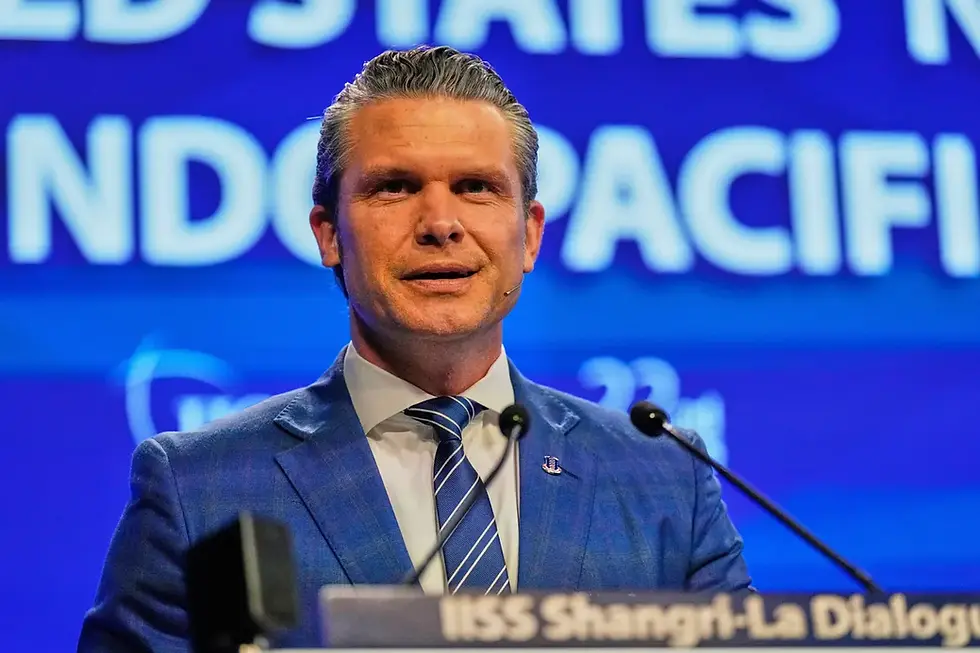
SYFCOM identifies the following as key insights:
[1] The U.S.'s increasingly binary rhetoric on the global stage has escalated, as it now labels China an 'imminent threat' to regional stability.
Hegseth issued a blunt warning about China’s growing military ambitions, with a particular focus on Taiwan. He asserted, “There is no reason to sugarcoat it. The threat China poses is real. And it could be imminent,” pointing to Beijing’s persistent military exercises as a sign of its intent to shift the balance of power in the Indo-Pacific. Describing China’s assertiveness in the South China Sea and mounting pressure on Taiwan as a regional 'wake-up call,' he called for heightened vigilance, while emphasizing that the goal is neither confrontation nor regime change.
[2] U.S. calls for "allies and partners" to boost defense spending.
This was noted as one of the main "overarching themes" of his remarks. Hegseth called for Indo-Pacific allies to boost their defense spending in order to strengthen regional deterrence. Citing NATO’s commitment to allocate 5% of GDP toward defense, he encouraged Asian partners to adopt similar measures, particularly in light of what he described as the “formidable threat” posed by both China and North Korea.
[3] Addressing Broader Regional Security Challenges
Although China remained the central focus of Hegseth’s remarks, he also acknowledged other external challenges, including North Korea and Russia, though he stopped short of explicitly labelling them as key actors of the “Axis of Upheaval” (a term coined to describe the growing anti-Western collaboration in the early 2020s) He stressed the importance of a forthcoming National Defense Strategy, slated for release by August 31, 2025, which will center on "deterring" China and promoting greater burden-sharing among allies. The strategy is expected to take a holistic approach to regional security, preparing the U.S. and its partners to confront a range of multi-domain threats.
[4] The need for stronger strategic partnerships and alliances.
Hegseth also highlighted the importance of collective defense and the need to leverage and build on multilateral frameworks like AUKUS, the Quad, and trilateral ties among regional partners like Japan and South Korea. Hegseth underscored a series of new joint initiatives with among those mentioned were expanded access to ship and aircraft maintenance facilities in Australia and the region’s first live-fire test of a mid-range missile system. He also stressed that there is a growing frequency and scale of joint military exercises and intelligence-sharing efforts with key allies, portraying these developments as strategic “force multipliers” in response to China’s rapid military modernization.
[5] Reiterating U.S. Commitment to the Indo-Pacific
Hegseth reaffirmed that U.S. continues to view the Indo-Pacific as a “priority theatre” and has plans to reposition military assets within the wider region to counter China’s influence.

China's Response
In response to U.S. Defense Secretary Pete Hegseth’s remarks at the Shangri-La Dialogue, The Chinese Foreign Ministry responded to Hegseth's remarks on Sunday (Jun. 1), saying that the U.S. Defence Secretary has "exaggerated the 'China threat theory'", promoted a Cold War mentality of bloc confrontation, and smeared and attacked China. The response further stated that "the Taiwan question is purely China's internal affair, and no foreign country has the right to interfere" as reported by Global Times
CNA reported that during a separate IISS Shangri-La panel on Saturday afternoon, China’s representative, Rear Admiral Hu Gangfeng, dismissed what he called “groundless accusations” from other speakers at the forum, describing them as “politically motivated” attempts to provoke conflict. Leading a delegation from the PLA’s National Defense University, Hu criticized foreign military deployments near China’s waters and reaffirmed Beijing’s opposition to “unilateralism” and “hegemonic bullying.”
Notably, China did not send its Defence Minister Dong Jun to this year’s forum, marking the first time since 2019 that Beijing’s defense chief was absent from the event.
SYFCOM's Stance
Strategic Youth Foreign Policy Community of Malaysia (SYFCOM) encourages all parties to deescalate tensions and actively pursue dialogue and confidence-building measures to prevent miscalculations in this increasingly complex and dynamic environment. We believe that peace and stability in the Indo-Pacific is a shared responsibility among all actors, relying on cooperative approaches that respect the sovereignty of nations while addressing genuinely legitimate, rather than mischaracterized, security concerns. As such, SYFCOM resonates particularly with Malaysia's Prime Minister Anwar Ibrahim's statement in his special address at the Shangri-La Dialogue:
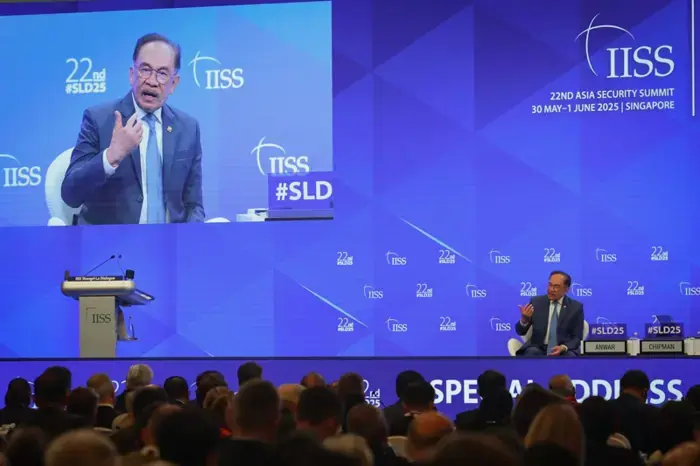
“Stability does not come from carving up the map, but from creating space for all to participate meaningfully in shaping the order we live in” - Malaysia's Prime Minister Anwar Ibrahim at the 22nd Shangri-La Dialogue 2025
In this context, SYFCOM believes that Malaysia should continue to take an “active non-alignment” approach to preserve its ability to act on its terms.
// END
Analyst: Edwin Oh Chun Kit
![[ANALYSIS] Between Battles: How the Iran-Israel/U.S. Conflict Might Accelerate Global Shifts](https://static.wixstatic.com/media/1e8ce2_5a3e4e1fc1294c08ae7e436a0d7baeaf~mv2.webp/v1/fill/w_960,h_540,al_c,q_85,enc_avif,quality_auto/1e8ce2_5a3e4e1fc1294c08ae7e436a0d7baeaf~mv2.webp)

![[OPINION] DEFA & ASEAN’s Digital Economies: A Strong Foundation, But Practicality Is Key](https://static.wixstatic.com/media/1e8ce2_07ace29ef5174f2cb51bff0acfd275be~mv2.webp/v1/fill/w_700,h_466,al_c,q_80,enc_avif,quality_auto/1e8ce2_07ace29ef5174f2cb51bff0acfd275be~mv2.webp)